With the box office success of the film “Interstellar”, many people are excited about the prospects of wormholes as a means for interstellar transport. Although there is currently no evidence that such exotic objects exist in nature, it is possible that they could be artificially created, perhaps from versions of higher dimensional string theory and engineering of the fundamental space-time foam. Wormhole research is today an exciting subject with dozens of papers published in peer-reviewed journals every year, but it is worthwhile to be reminded of its origins — and it starts from a surprising place.
In 1915 Albert Einstein published his general theory of relativity, his description of gravity that neatly defines how objects will attract one another and affect the space and time around them. Many years later the American physicist John Wheeler would coin the phrase “space tells matter how to move, and matter tells space how to curve”. Einstein described gravity as a manifestation of space-time curvature. General Relativity is a continuous field theory in contrast to the particle theory of matter which led to quantum mechanics.
Einstein was also involved in the development of quantum mechanics, the theory that describes sub-atomic particles. But he was not entirely happy with its inherent uncertainties and probabilistic character. So in 1935, he worked with Nathan Rosen to produce a field theory for electrons, using general relativity. Their paper was titled “The Particle Problem in the General Theory of Relativity”[1]. Einstein and Rosen were investigating the possibility of an atomistic theory of matter and electricity which, excluding discontinuities (singularities) in the field, made use of no other variables other than the description (metric) of general relativity and Maxwell's electromagnetic theory. One of the consequences was that the most elementary charged particle was found to be one of zero mass.
In the end, what they produced was something quite original. They started with the equations for a spherically symmetric mass distribution, already used for black holes, and known as the Schwarzschild solution,
$$ds^2 = -\dfrac{1}{1-2m/r}dr^2 - r^2(d\theta^2+\sin^2\theta d\phi^2) + (1-2m/r)dt^2$$
where \(ds^2\) is the metric and \(m=GM/c^2\) with spherical coordinates \((r,\theta,\phi)\) and time \(t\).
They performed a coordinate transformation to remove the region containing the curvature singularity, a discontinuity in space curvature implied by black holes and similar phenomena. The singularity at \(r=2m\) was removed by the coordinate transformation \(u^2 = r - 2m\), resulting in a final solution,
$$ds^2 = -4(u^2 + 2m)du^2 - (u^2 + 2m)^2 d\Omega^2 + \dfrac{u^2}{u^2 + 2m} dt^2$$
where \(d\Omega^2 = d\theta^2 + \sin^2\theta d\phi^2\).
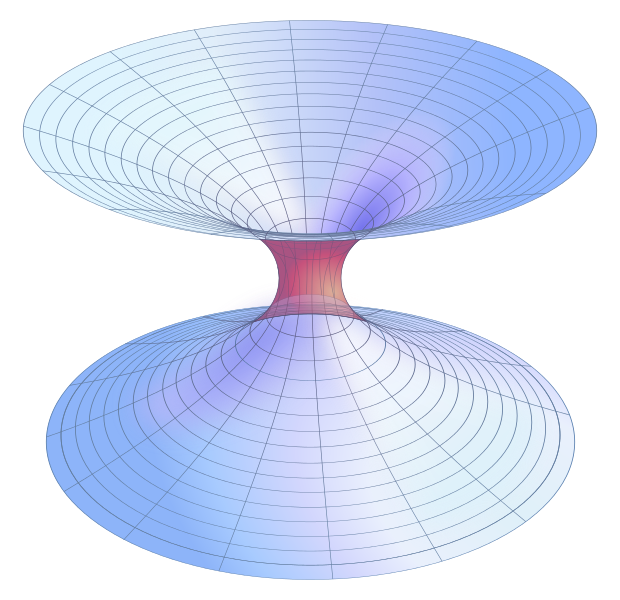
This solution was a mathematical representation of physical space by a space of two asymptotically flat sheets connected by a bridge or a Schwarzschild wormhole with a ‘throat’. This connects the two sheets and, by analogy, two separate parts of the real, three dimensional, universe. Figure 1 shows the space around the wormhole, with the space above and below becoming flat at the "edges" as you zoom out to infinity.
Now this was not a traversable wormhole, for that we had to await the arrival of physicists John Wheeler in the 1950s and Kip Thorne in the 1980s. In 1987, with the encouragement of Carl Sagan for his novel “Contact” (later a feature film), Thorne and his colleague Michael Morris were able to construct a mathematical description, a metric, to describe a spherically symmetric and static wormhole with a real, finite, circumference. This had a co-ordinate decreasing from negative infinity — out in minimally-curved space — to a minimum value where the throat was located, and then increasing from the throat to positive infinity — in a different minimally-curved space. This solution has the distinctive feature of having no event horizon — unlike a black hole. The Thorne and Morris paper was titled “Wormholes in Space-time and their use for Interstellar Travel: A Tool for Teaching General Relativity”[2]. This paper helped to establish wormhole research as new area of academic enquiry.
Since then, many papers have been published, and indeed astronomical surveys have been conducted, examining the furthest stars and galaxies in search of natural wormholes. None have been identified yet, but remember the origin of this field of research — the Einstein-Rosen Bridge was not a traversable wormhole, and it wasn’t the author’s intention to produce one, yet they did produce the first mathematical description of a wormhole. They should be remembered for this. Science research often produces something quite unexpected with implications reaching far beyond the original intentions of the researchers.
Kelvin F. Long
Since this article was published, our magazine, Principium, has published two issues (issues 9 & 10) where we discuss wormholes and the Einstein-Rosen Bridge in more detail. These issues also detail the one day symposium on "Interstellar Wormholes: Physics and Practical Realisation" organised by the Initiative for Interstellar Studies in collaboration with the British Interplanetary Society.
Join the Initiative for Interstellar Studies and receive our regular newsletter on everything interstellar. Members also get early access to our magazine, Principium, as well as free access to some of our other publications. Students can join at a special reduced rate.
References
- Einstein, A., & Rosen, N. (1935). The Particle Problem in the General Theory of Relativity. Physical Review, 48(1), 73–77. https://doi.org/10.1103/physrev.48.73
- Morris, M. S., & Thorne, K. S. (1988). Wormholes in spacetime and their use for interstellar travel: A tool for teaching general relativity. American Journal of Physics, 56(5), 395–412. https://doi.org/10.1119/1.15620